ANREF Russian Front Photo Album
Price available on inquiry
ID: 12-0280
Categories: 20th Century, Books, Historical, Items, Unique Historical
ANREF Russian Front
This page offers a glimpse into the urban and infrastructural environment of Archangel during the Allied intervention in the Russian Civil War. Each photo illustrates aspects of the city critical to the American Expeditionary Forces: its public spaces, logistical routes, and administrative hubs. Together, they provide a narrative of a city that served as a strategic foothold for the Allies, balancing its civilian life with its role in a military campaign.

Top Left Photo:
Caption: “Rose Gardens and Park, Archangel, 1918.”
Description: The photograph shows a landscaped park area with well-maintained paths and a central fountain. Trees and buildings line the background, giving the sense of a structured urban park. The perspective suggests it is a significant public area in Archangel.
Historical Context: Archangel (Arkhangelsk) was a key city during the Allied intervention in North Russia. This park reflects a more peaceful side of the city, contrasting the military presence and harsh conditions experienced by the American and Allied troops in 1918-1919.
Suggested Caption: “Rose Gardens and Park in Archangel, a rare moment of tranquility during the American Expedition in North Russia, 1918.”
Top Right Photo:
Caption: “Bridge over Dvina River, Archangel, 1918.”
Description: This image depicts a bridge spanning the Dvina River with nearby structures and the cityscape of Archangel in the distance. The elevated perspective shows rail tracks and urban infrastructure.
Historical Context: The Dvina River was a critical logistical route for both the Allies and the Bolsheviks. Control over bridges like this was essential for transportation and supply lines during the intervention.
Suggested Caption: “Bridge over the Dvina River, a vital route for transportation in Archangel, 1918.”
Bottom Left Photo:
Caption: “Troops Transport Route, Archangel, 1918.”
Description: A view of a long, straight road or railway line cutting through a city, with houses and structures on either side. The photo captures an essential route used by military personnel for transport.
Historical Context: The railways and roads in Archangel were lifelines for Allied forces, allowing troops and supplies to move across the region. The American Expeditionary Forces often faced challenges with snow, ice, and guerrilla attacks on such routes.
Suggested Caption: “A primary transport route used by Allied troops in Archangel, 1918.”
Bottom Right Photo:
Caption: “Government Building, Archangel, 1918.”
Description: A large, imposing building with classical architectural features, including columns and symmetrical design. The flag on the building suggests its importance as a government or administrative center.
Historical Context: Archangel served as a hub of administration during the Allied intervention. Government buildings like this were central to coordinating military and political efforts against Bolshevik forces.
Suggested Caption: “Government building in Archangel, a center of Allied administration during the North Russian campaign, 1918.”
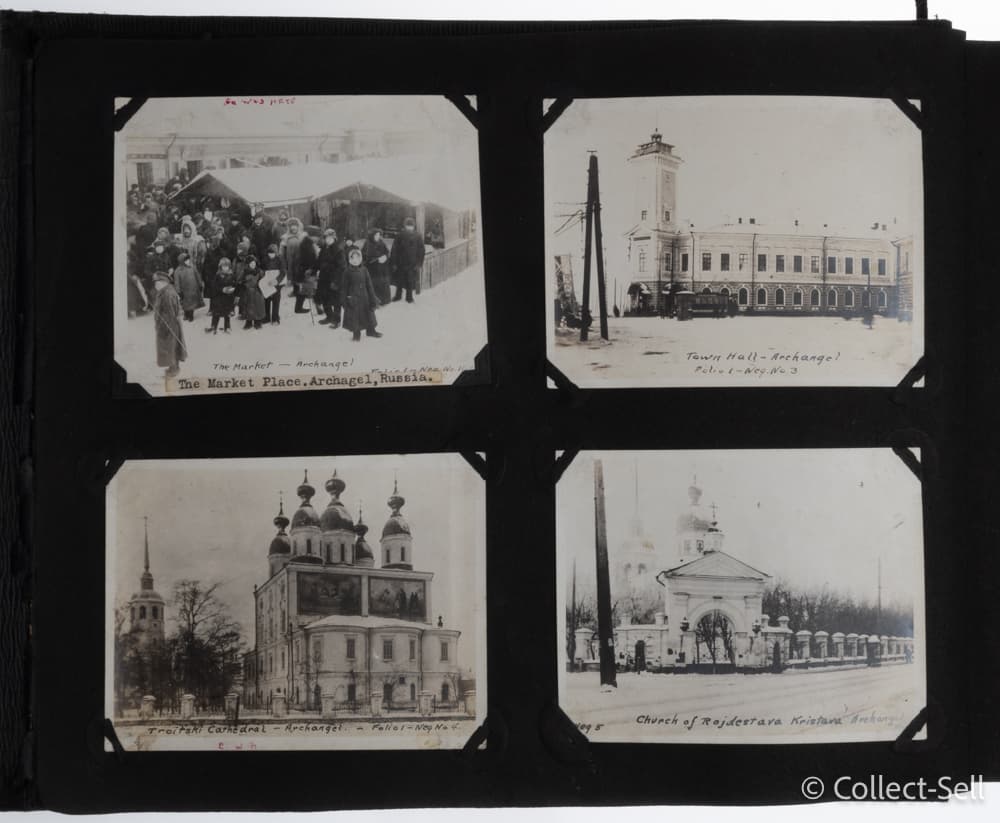
This page provides a deeper glimpse into Archangel’s cultural, civic, and religious life during the American Expeditionary Forces’ stay in 1918. The photos showcase the market’s vibrant activity, the town hall’s administrative significance, and the architectural beauty of Orthodox churches like Troitski Cathedral and the Church of the Nativity. Together, they highlight the contrast between civilian life and military operations during the Allied intervention in North Russia.

Top Left Photo:
Caption: “The Market – Archangel. The Market Place, Archangel, Russia.”
Description: A bustling marketplace scene with a crowd of people, many dressed in heavy winter clothing. Small market stalls are visible in the background, likely selling local goods. The photo captures the daily life of civilians in Archangel during the time of the American Expedition.
Historical Context: Markets like this were vital for the local population, especially during the harsh winters of North Russia. For the Allied troops stationed in Archangel, observing or interacting with the local economy would have been a unique cultural experience amidst military duties.
Suggested Caption: “The Market Place in Archangel, Russia, a hub of civilian life during the Allied presence, 1918.”
Top Right Photo:
Caption: “Town Hall – Archangel.”
Description: A prominent building with a clocktower, likely used as a government or municipal headquarters. The surrounding area is snowy, and the structure’s architecture stands out as a symbol of civic administration.
Historical Context: Archangel’s town hall would have been a key site for coordinating local governance during the Allied intervention. Such buildings often hosted meetings or served administrative functions necessary for maintaining order in the occupied city.
Suggested Caption: “Archangel Town Hall, a center of local governance during the Allied intervention in North Russia, 1918.”
Bottom Left Photo:
Caption: “Troitski Cathedral – Archangel.”
Description: The photo shows Troitski Cathedral, a classic Russian Orthodox structure with multiple domes and ornate architectural details. A bell tower stands nearby, and the cathedral is surrounded by trees and light snow.
Historical Context: The Troitski Cathedral was an important religious and cultural site in Archangel. For Allied troops, encountering Russian Orthodox churches would have been a unique element of their time in North Russia, adding to the cultural contrast with their homeland.
Suggested Caption: “Troitski Cathedral, a significant Russian Orthodox church in Archangel, 1918.”
Bottom Right Photo:
Caption: “Church of Rozhdestava Khrista – Archangel.”
Description: This image shows the Church of the Nativity (Rozhdestava Khrista), a smaller but still architecturally significant church with a distinct entrance and surrounding fence. Trees in the background frame the scene.
Historical Context: Churches like the Church of the Nativity reflected the deep-rooted religious traditions of the region, even during times of war and revolution. Such landmarks also served as a reminder of the cultural and spiritual life of the Russian people amid the broader conflict.
Suggested Caption: “Church of the Nativity in Archangel, representing the city’s enduring religious traditions, 1918.”
This page combines poetic reflection with visual documentation of Archangel’s key sites. The poem poignantly parallels the hardships of the North Russian campaign with the familiar imagery of Flanders Fields, while the photos illustrate life in Archangel: its docks, natural landscapes, administrative buildings, and preserved history. Together, they provide a narrative of both the soldiers’ struggles and the city’s enduring significance.

Text on the Left Page:
This appears to be a poem, drawing inspiration from John McCrae’s In Flanders Fields, but tailored to the Russian campaign:
Transcription:
In Russian fields, no poppies blow
There are no crosses row on row
That mark our places, and in the sky
No lark so bravely singing fly
As in the Fields of Flanders.
We are the dead not long ago
Who fought beside you in the snow
And gave our lives and now we lie
Though scarcely know the reason why
As those in Flanders Fields.
At Ust Padenga where we fell
Vistavka with its shot and shell
We fought with just as fierce a foe
As those who sleep where poppies
Grow in Flanders Fields.
And as you fare upon your way
That leads you to a better day
And leave us here to sleep and rest
Just tell them we did our best
Here in the Fields of Russia.
Context:
This poem reflects the soldiers’ somber perspective on their campaign in North Russia, contrasting their experiences with the well-known imagery of World War I’s Western Front. It mentions Ust Padenga and Vystavka, sites of significant skirmishes during the Allied intervention against the Bolsheviks.
Top Left Photo:
Caption: “View of the Docks, Archangel.”
Description: A wintery view of Archangel’s docks, showing moored ships and industrial buildings in the background. Snow blankets the area, indicating the harsh conditions faced by troops.
Historical Context:
Archangel’s docks were a crucial hub for receiving supplies and reinforcements from Allied forces. Ice and snow frequently disrupted shipping and posed logistical challenges.
Suggested Caption: “The docks at Archangel, a key supply point for Allied operations in North Russia, 1918.”
Top Right Photo:
Caption: “Scene by Dvina.”
Description: A snowy landscape with a fence lining the path near the Dvina River. Frost-covered trees and an overcast sky evoke the cold, bleak conditions.
Historical Context:
The Dvina River, central to Archangel’s geography, was often a site of both natural beauty and strategic importance. Winter conditions made travel and logistics particularly arduous for the Allied troops.
Suggested Caption: “A serene but icy scene along the Dvina River during the North Russian campaign, 1918.”
Bottom Left Photo:
Caption: “Governor General’s House – Archangel.”
Description: A large, stately building with columns and a central flagpole. Its symmetrical design and prominence indicate its use as a seat of authority.
Historical Context:
The Governor General’s House served as an administrative center during both Russian Imperial rule and the Allied occupation. It likely played a role in organizing local governance during the intervention.
Suggested Caption: “The Governor General’s House in Archangel, a focal point for administrative activity during the Allied intervention, 1918.”
Bottom Right Photo:
Caption: “Peter the Great’s Carriage – Archangel.”
Description: A wooden structure houses a historical carriage, likely associated with Peter the Great. The ornate vehicle is protected from the elements by a roof and fencing.
Historical Context:
Peter the Great, who founded the city of Saint Petersburg, had significant influence over Russia’s modernization. This carriage, preserved in Archangel, is a historical artifact that connects to Russia’s imperial past.
Suggested Caption: “Peter the Great’s historic carriage, preserved as a relic in Archangel, 1918.”
This page highlights the cultural and social aspects of life in Archangel during the American Expeditionary Forces’ time there. The religious processions, bustling market, and military parade illustrate a city balancing its traditional identity with the presence of foreign troops and the backdrop of war. These images provide a vivid contrast between civilian resilience and military operations during the North Russian campaign.

Caption: “Church Parade – Archangel.”
Description: A procession of people, including clergy and civilians, carrying religious icons and banners. The group is walking down a snowy street lined with buildings, likely as part of a religious or cultural observance.
Historical Context:
Religious processions were a significant part of life in Orthodox Russia, even amidst political and military turmoil. For Allied forces in Archangel, witnessing such events would have offered insight into local traditions and resilience during uncertain times.
Suggested Caption: “A Church Parade in Archangel, showcasing the strong Orthodox traditions of the region, 1918.”
Top Right Photo:
Caption: “The Market – Archangel.”
Description: A bustling marketplace, with vendors and shoppers gathered around stalls and goods spread on the snowy ground. The surrounding structures appear to be market arches or buildings typical of Russian town centers.
Historical Context:
Markets like this served as essential hubs of commerce and social interaction for Archangel’s residents. For Allied troops, they provided opportunities to observe local culture and purchase items beyond military rations.
Suggested Caption: “A bustling winter market in Archangel, a vital part of civilian life during the Allied occupation, 1918.”
Bottom Left Photo:
Caption: “Parade.”
Description: A formal military parade, with soldiers marching in formation along a street. Wooden houses and trees line the road, suggesting a small-town or suburban setting.
Historical Context:
Military parades were a common way to boost morale, demonstrate discipline, and instill confidence among both troops and civilians. This photo may depict Allied or Russian forces maintaining order or celebrating an event.
Suggested Caption: “A formal military parade showcasing discipline and unity among troops stationed in North Russia, 1918.”
Bottom Right Photo:
Caption: “Church Parade – Archangel.”
Description: A larger religious procession in snowy conditions, with a mix of clergy, civilians, and children participating. In the background, there are buildings and trees, reinforcing the wintry setting of Archangel.
Historical Context:
This procession likely coincided with a major religious holiday or Orthodox Church event. Such gatherings underscored the importance of faith and tradition, even during times of political upheaval and military occupation.
Suggested Caption: “A grand Church Parade in Archangel, reflecting the strong religious and cultural identity of the local community, 1918.”
This page emphasizes the military aspects of the Allied intervention in North Russia. The photographs showcase formal reviews, parades, and the awarding of medals, reflecting discipline and morale among the troops. The presence of British and American leadership highlights the multinational nature of the intervention, and the base camp provides a glimpse into the day-to-day life of soldiers in Archangel.

Top Left Photo:
Caption: “Men who received medals.”
Description: A group of soldiers standing in formation, receiving military honors. They are lined up neatly in their uniforms, with an officer presenting awards. A building is visible in the background, suggesting this took place in a formal setting.
Historical Context:
Medals were awarded to recognize bravery and service during the campaign. Such ceremonies boosted morale and underscored the contributions of individual soldiers in challenging conditions.
Suggested Caption: “Soldiers honored with medals for their service during the North Russian campaign, 1918.”
Top Right Photo:
Caption: “Gen. Ironside and Gen. Richardson reviewing Battalion, June 1919.”
Description: Generals Ironside and Richardson are seen observing a battalion marching in formation. The parade ground has tents and trees in the background, creating a military camp atmosphere.
Historical Context:
General Sir Edmund Ironside commanded British forces in North Russia, while General Richardson played a key role in the American Expedition. Such reviews were a regular occurrence to assess troop readiness and instill discipline.
Suggested Caption: “Generals Ironside and Richardson reviewing troops during the North Russian campaign, June 1919.”
Bottom Left Photo:
Caption: “English Troops Parading After Arrival – Archangel.”
Description: A contingent of English soldiers marches down a street, likely newly arrived in Archangel. Civilians and other troops appear in the background, watching the parade.
Historical Context:
British troops were part of the Allied intervention in North Russia, working alongside American and other Allied forces. Their arrival would have been a coordinated effort to bolster the campaign against the Bolsheviks.
Suggested Caption: “English troops parade through Archangel after their arrival to support Allied operations, 1918.”
Bottom Right Photo:
Caption: “Base Camp – Archangel.”
Description: A group of soldiers stands in formation at what appears to be a base camp. The scene includes wooden buildings and trees, suggesting a semi-permanent settlement for Allied forces.
Historical Context:
Base camps like this were essential for organizing operations, housing troops, and maintaining supply lines in the harsh environment of North Russia.
Suggested Caption: “Base camp in Archangel, serving as a hub for Allied operations during the intervention, 1918.”
This page provides a detailed look at key infrastructure and cultural landmarks in Archangel during the Allied intervention. From the essential supply depot and transportation routes to the iconic Troitski Cathedral, the photos illustrate the interplay between military logistics and the city’s civilian and cultural life. Together, they highlight the challenges and adaptations required to operate in the harsh Russian winter while respecting the region’s traditions and history.

Caption: “Bridge and Car Track on Ice to Solombala – Archangel.”
Description: A bridge and ice track leading toward the Solombala district of Archangel. The infrastructure appears to facilitate transportation over frozen terrain, with snow-covered surroundings and minimal visible activity.
Historical Context:
Solombala was a critical area in Archangel, serving as a hub for shipbuilding and trade. During the Allied intervention, ice tracks like this were vital for transporting supplies and troops across the frozen rivers during winter.
Suggested Caption: “Bridge and ice car track connecting Archangel to the Solombala district, a crucial supply route during the harsh winter, 1918.”
Top Right Photo:
Caption: “300th Engineers Supply Depot.”
Description: A supply depot building with a sign above the entrance. The area is bustling with activity, featuring horse-drawn carts and groups of men loading or unloading supplies.
Historical Context:
The 300th Engineers played a significant role in establishing and maintaining supply lines for the Allied forces. Depots like this were critical in ensuring the steady flow of equipment, food, and other essentials despite the challenging conditions in North Russia.
Suggested Caption: “The 300th Engineers Supply Depot, a vital logistical center supporting Allied troops in Archangel, 1918.”
Bottom Left Photo:
Caption: “Solombala from Archangel.”
Description: A view across the river toward Solombala, showing structures along the shoreline. The snowy and icy terrain emphasizes the region’s harsh climate and its impact on daily life and operations.
Historical Context:
Solombala’s proximity to Archangel made it an integral part of the city’s economy and military efforts. The frozen rivers served as natural barriers but also became transportation routes during the winter months.
Suggested Caption: “A view of Solombala from Archangel, highlighting the interconnectedness of these districts during the campaign, 1918.”
Bottom Right Photo:
Caption: “Troitski Cathedral – Archangel.”
Description: The interior of Troitski Cathedral, featuring intricate Orthodox iconography, chandeliers, and ornate decorations. The space exudes reverence and cultural significance.
Historical Context:
Troitski Cathedral was a major religious and cultural landmark in Archangel. For Allied soldiers, visits to such places may have provided moments of peace and an opportunity to learn about Russian traditions.
Suggested Caption: “The ornate interior of Troitski Cathedral in Archangel, showcasing the region’s rich Orthodox heritage, 1918.”
This page highlights the strategic and logistical aspects of the Allied intervention in Archangel. From the headquarters of the 300th Engineers to the construction of essential infrastructure and the presence of naval support, it paints a picture of the multinational effort to maintain operations in the harsh winter climate. The inclusion of an American hospital and French cruiser emphasizes the breadth of international cooperation during this campaign.

Top Left Photo:
Caption: “300th Engineers Headquarters Building.”
Description: A modest wooden building with a small porch and an automobile parked outside. It appears to be the operational headquarters for the 300th Engineers.
Historical Context:
The 300th Engineers played a vital role in constructing infrastructure to support Allied forces in North Russia. Buildings like this served as centers for planning and coordination, reflecting the logistical complexity of the campaign.
Suggested Caption: “The 300th Engineers Headquarters in Archangel, where logistical and operational planning for the North Russian campaign took place, 1918.”
Top Right Photo:
Caption: “Church – American Hospital – American Huts, Archangel.”
Description: A wide view of a church and nearby buildings, including what appears to be hospital huts used by American forces. The snow-covered landscape emphasizes the harsh conditions.
Historical Context:
The church and surrounding huts were likely repurposed to serve the Allied forces. Hospitals were crucial in providing medical care to troops affected by injuries, frostbite, and illness in the severe climate.
Suggested Caption: “A church and nearby American hospital huts in Archangel, supporting Allied medical operations during the North Russian campaign, 1918.”
Bottom Left Photo:
Caption: “Saw Pit – Snow under Construction, 300th Engineers.”
Description: Soldiers of the 300th Engineers are shown constructing a building in snowy conditions. Wooden beams and ladders dominate the scene, with men working on scaffolding and the ground.
Historical Context:
The 300th Engineers were responsible for constructing essential facilities such as barracks, depots, and other infrastructure. Their work under extreme winter conditions highlights the challenges faced by Allied forces in maintaining operational capabilities.
Suggested Caption: “Engineers of the 300th constructing facilities in Archangel under harsh winter conditions, 1918.”
Bottom Right Photo:
Caption: “French Cruiser.”
Description: A French naval cruiser docked in icy waters. Its large masts and silhouette emphasize its role as a military vessel supporting the Allied effort.
Historical Context:
The French Navy contributed to the Allied intervention in North Russia by providing naval support and protecting supply routes. Ships like this also served as a reminder of the multinational effort against the Bolsheviks.
Suggested Caption: “A French naval cruiser docked near Archangel, providing crucial support to Allied operations in North Russia, 1918.”
This page provides a glimpse into the labor and infrastructure of Archangel during the Allied intervention. From prisons and prisoners contributing to construction efforts to the presence of naval assets like submarines and the use of manual sawmills, these images highlight the resourcefulness and harsh realities of life in North Russia. The conditions depicted underscore the physical and logistical challenges faced by both soldiers and civilians during this campaign.

Top Left Photo:
Caption: “Archangel Prison.”
Description: A large, rectangular building with rows of small windows, typical of institutional architecture. The surrounding area is sparse and covered in snow.
Historical Context:
During the Allied intervention, prisons like this were used to house a range of individuals, from local criminals to captured Bolsheviks. Conditions in such facilities were likely harsh, reflecting the severe climate and limited resources of the time.
Suggested Caption: “Archangel Prison, a stark institution used during the Allied intervention in North Russia, 1918.”
Top Right Photo:
Caption: “Russian Submarine.”
Description: A partially snow-covered Russian submarine is docked, with workers or sailors nearby attending to maintenance. Steam or smoke is visible, likely from a nearby vessel or the submarine itself.
Historical Context:
The presence of a submarine reflects the naval capabilities of Russia at the time. Submarines and other naval vessels in Archangel played roles in protecting waterways and supporting military operations, although the severe winter limited their use.
Suggested Caption: “A Russian submarine docked in Archangel, showcasing the region’s naval activities during the campaign, 1918.”
Bottom Left Photo:
Caption: “Hand Saw-Mill – Archangel.”
Description: Workers operate a hand sawmill in snowy conditions, with one man standing on top of the timber structure while another works below. The setup appears makeshift but functional.
Historical Context:
Sawmills like this were essential for producing timber, a vital resource for constructing barracks, supply depots, and other infrastructure. The reliance on manual labor in such harsh conditions underscores the challenges faced by workers and engineers.
Suggested Caption: “A hand sawmill operated in Archangel, providing vital timber for Allied operations during the North Russian campaign, 1918.”
Bottom Right Photo:
Caption: “Prisoners Working – Archangel.”
Description: A group of individuals, likely prisoners, is seen working outdoors in snowy conditions. They are dressed in heavy winter clothing and appear to be handling timber or other construction materials.
Historical Context:
Prison labor was commonly used for tasks such as building infrastructure or processing resources. These prisoners were likely part of the efforts to sustain operations in Archangel during the Allied intervention.
Suggested Caption: “Prisoners working in Archangel, contributing to construction and logistical efforts during the campaign, 1918.”
This page highlights both the logistical and human aspects of life in Archangel during the Allied intervention. From recreational activities like the Army vs. Navy game to the essential planning in the engineers’ drafting room and the construction of critical infrastructure like bridges, these images depict the range of activities that sustained the campaign. The inclusion of the sleigh mail service underscores the ingenuity and resilience required to maintain connections in the harsh climate.

Top Left Photo:
Caption: “‘Ten Out’ Army & Navy Game – Archangel.”
Description: A field where soldiers are engaged in what appears to be a sporting event, likely a casual baseball game. A small structure and players are visible in the distance.
Historical Context:
Sports and recreational activities were vital for morale among troops stationed in remote and harsh environments like Archangel. Games between Army and Navy units provided camaraderie and a temporary reprieve from the challenges of military service.
Suggested Caption: “An Army vs. Navy baseball game in Archangel, a recreational activity to boost troop morale, 1918.”
Top Right Photo:
Caption: “Drafting Room – Engineers.”
Description: A group of engineers works diligently in a drafting room, drawing plans and reviewing designs. The interior appears to be a wooden building, with a stove or chimney for heat.
Historical Context:
Engineers were crucial for planning and constructing infrastructure such as roads, barracks, and supply depots. Drafting rooms like this were the operational hubs for such logistical planning, even in the extreme conditions of North Russia.
Suggested Caption: “Engineers in Archangel drafting plans for infrastructure and logistical projects, essential for the Allied intervention, 1918.”
Bottom Left Photo:
Caption: “Bridge under Construction – Mechka.”
Description: A wooden bridge under construction in a forested area. Logs, tools, and workers are visible, showcasing the challenging conditions in which such projects were undertaken.
Historical Context:
Bridges like this were critical for connecting remote areas, allowing troops and supplies to move more effectively through the North Russian terrain. The work required significant effort and resourcefulness, especially in snowy and forested conditions.
Suggested Caption: “A bridge under construction near Mechka, a vital project for improving transportation and supply lines, 1918.”
Bottom Right Photo:
Caption: “Sleigh Mail – Archangel.”
Description: A horse-drawn sleigh is pictured with two individuals, possibly delivering or receiving mail. The snowy backdrop and simple sleigh design reflect the region’s reliance on traditional transport methods in winter.
Historical Context:
Mail was a lifeline for soldiers stationed far from home, providing news and morale boosts. Sleighs were a practical means of transport in Archangel’s snowbound conditions, ensuring communication despite the challenging environment.
Suggested Caption: “Sleigh mail service in Archangel, a crucial link for communication during the North Russian campaign, 1918.”
This page showcases various logistical and cultural aspects of the Allied intervention in Archangel. From Laplander reindeer teams and wood sawyers supporting critical operations to the Michigan barracks housing troops and the ceremonial display of the American Color Guard, these images highlight the resourcefulness and resilience of soldiers and locals in the face of harsh conditions.

Top Left Photo:
Caption: “Laplanders with Reindeer Teams – Archangel.”
Description: A group of individuals with reindeer teams stands in a snowy landscape, possibly preparing for transport. Wooden buildings are visible in the background.
Historical Context:
Reindeer teams were commonly used in the Arctic and sub-Arctic regions for transportation, particularly in winter. The Allied forces likely interacted with local Laplanders, who were skilled in using reindeer for hauling supplies over snow and ice.
Suggested Caption: “Laplanders with reindeer teams in Archangel, providing crucial support for transportation in the harsh Arctic conditions, 1918.”
Top Right Photo:
Caption: “Wood Sawyers – Archangel.”
Description: Workers are sawing wood in a large snowy yard, surrounded by piles of logs. The scene suggests a significant operation to produce timber for construction or fuel.
Historical Context:
Timber was a critical resource for the Allied intervention, used for building infrastructure and heating in the extreme winter. Sawyers like these played a vital role in maintaining operations.
Suggested Caption: “Wood sawyers at work in Archangel, processing timber essential for Allied infrastructure and heating needs, 1918.”
Bottom Left Photo:
Caption: “Michigan Barracks – Archangel.”
Description: A row of wooden barracks with soldiers standing in front. The structures are simple, reflecting the temporary nature of the accommodations.
Historical Context:
The Michigan troops were part of the American Expeditionary Forces in North Russia. Barracks like these provided essential shelter for soldiers, though they were often rudimentary and poorly insulated against the cold.
Suggested Caption: “Michigan troops barracks in Archangel, serving as temporary housing during the North Russian campaign, 1918.”
Bottom Right Photo:
Caption: “American Color Guard.”
Description: Three American soldiers stand proudly with the U.S. flag, likely during a ceremonial or formal occasion. Tents are visible in the background, indicating a camp setting.
Historical Context:
The American Color Guard was a symbol of pride and unity for troops serving far from home. Ceremonies with the national flag reinforced morale and reminded soldiers of their mission and connections to their country.
Suggested Caption: “American Color Guard stands proudly at a camp in North Russia, embodying the spirit and unity of the expeditionary forces, 1918.”
This page captures both the operational and human aspects of the Allied intervention in Archangel. The engraving press and panoramic view reflect the logistical and geographical challenges, while the Dutch quarters and General Miller’s speech highlight the living conditions and leadership efforts in maintaining morale and order. Together, these images provide a well-rounded narrative of daily life and strategic activities during the campaign.

Caption: “Engraving Press – Archangel.”
Description: A group of individuals operates an engraving press, possibly printing maps, documents, or signs. The machinery is central, with tools and materials surrounding the workspace.
Historical Context:
An engraving press like this was essential for producing maps, official documents, and signage for logistical and operational purposes. Such tools helped coordinate efforts across the Allied forces and communicate effectively in unfamiliar territory.
Suggested Caption: “An engraving press in Archangel used to produce maps and materials critical for Allied operations, 1918.”
Top Right Photo:
Caption: “View of Panorama – Archangel.”
Description: A snowy panorama of Archangel, showing wooden houses and winding tracks cutting through the snow. The settlement appears sparsely populated, reflecting the harsh winter environment.
Historical Context:
This view highlights the rural and challenging nature of life in Archangel during the Allied intervention. The tracks and snow-covered homes underscore the logistical challenges faced by troops and locals alike.
Suggested Caption: “A panoramic view of Archangel during the Allied intervention, showcasing the snowy and sparse landscape, 1918.”
Bottom Left Photo:
Caption: “HQ’s Dutch Quarters – Archangel.”
Description: The interior of a modest room, with bunk beds and soldiers’ belongings hanging neatly on racks. The setup is utilitarian, emphasizing functionality over comfort.
Historical Context:
Quarters like this housed officers and soldiers in Archangel. The sparse accommodations reflect the makeshift nature of Allied operations in North Russia, where comfort was often secondary to utility.
Suggested Caption: “Dutch Headquarters quarters in Archangel, reflecting the utilitarian living conditions during the North Russian campaign, 1918.”
Bottom Right Photo:
Caption: “General Miller Speaking.”
Description: General Miller addresses a group of soldiers lined up in formation. Civilians and other officers stand nearby, possibly witnessing a formal occasion or inspection.
Historical Context:
General Eugene Miller was a key figure in the White Russian forces during the Allied intervention. Public speeches and reviews like this were common to boost morale and emphasize the importance of the mission against Bolshevik forces.
Suggested Caption: “General Miller addressing troops in Archangel, highlighting his leadership role during the Allied intervention, 1918.”
This page captures various aspects of life and operations in Archangel during the Allied intervention. From daily tasks on the Dvina River to the strategic presence of naval gunboats and icebreakers, the images highlight the interplay of civilian and military life in this northern city. The inclusion of the fire department and rural street scenes further enriches the narrative of resilience and adaptability during this campaign.

Top Left Photo:
Caption: “Washing on Dvina River.”
Description: A person is seen washing items on the frozen or snowy banks of the Dvina River, with simple tools such as buckets and wooden implements nearby.
Historical Context:
The Dvina River was central to life in Archangel, serving as a water source and transportation route. Daily activities like washing took place even in the harsh winter conditions, reflecting the resilience of the local population.
Suggested Caption: “A person washing on the Dvina River, showcasing daily life in the harsh winter environment of Archangel, 1918.”
Top Right Photo:
Caption: “310th Engineers Headquarters Guard – Archangel.”
Description: A group of soldiers stands in front of a wooden building, posing with the U.S. flag. The scene appears formal, possibly documenting their role in guarding the headquarters.
Historical Context:
The 310th Engineers played a significant role in maintaining security and building infrastructure during the Allied intervention. Guards like these ensured the safety of key facilities and personnel in Archangel.
Suggested Caption: “Guards of the 310th Engineers Headquarters in Archangel, tasked with maintaining security during the campaign, 1918.”
Middle Left Photo:
Caption: “British Gunboats Wintering in Solombala.”
Description: A row of British gunboats docked in the icy waters of Solombala. The vessels are surrounded by snow, and personnel can be seen attending to them.
Historical Context:
British gunboats provided naval support for the Allied forces in North Russia, protecting supply routes and engaging Bolshevik forces. Wintering in Solombala ensured their readiness for spring operations.
Suggested Caption: “British gunboats wintering in Solombala, a crucial element of Allied naval support during the North Russian campaign, 1918.”
Middle Right Photo:
Caption: “Street Scene – Archangel.”
Description: A corner of a street with a post covered in Cyrillic advertisements or notices. Goats or sheep are seen in the foreground, emphasizing the rural character of the area.
Historical Context:
Scenes like this illustrate the blend of urban and rural life in Archangel. The presence of livestock on the streets highlights the integration of agricultural practices into daily city life during this period.
Suggested Caption: “A street scene in Archangel, capturing the coexistence of urban and rural elements during the Allied occupation, 1918.”
Bottom Left Photo:
Caption: “Icebreaker Canada – Caught in White Sea – April 1919.”
Description: The icebreaker “Canada” is shown caught in icy conditions in the White Sea. Crew members appear to be working on the vessel or observing the surrounding ice.
Historical Context:
Icebreakers like this were critical for keeping supply lines open in the frozen waters of the White Sea, which connected Archangel to the outside world. The severe ice often trapped ships, delaying operations.
Suggested Caption: “The icebreaker Canada caught in the frozen White Sea, highlighting the challenges of maintaining supply routes, April 1919.”
Bottom Right Photo:
Caption: “Archangel Fire Department.”
Description: A group of individuals and horses stands in front of the Archangel Fire Department, with a fire engine or cart visible. The building is simple, reflecting the utilitarian nature of such facilities.
Historical Context:
The fire department in Archangel was vital for protecting the wooden structures that dominated the city from fire hazards, especially during winter when heating posed increased risks.
Suggested Caption: “The Archangel Fire Department, an essential service in a city dominated by wooden architecture, 1918.”
This page illustrates the logistical and infrastructural efforts that sustained the Allied forces in North Russia. From the Michigan barracks providing troop housing to the wireless station ensuring communication and the ice railroad enabling transport, these photos capture the resourcefulness required to operate in extreme conditions. The motor launch underscores the importance of waterways in this remote region.

Top Left Photo:
Caption: “Michigan Barracks – Archangel.”
Description: Rows of wooden barracks covered in snow, showing a simple but organized military housing arrangement. The uniformity and sparse surroundings reflect the functional nature of the facilities.
Historical Context:
These barracks housed Michigan troops as part of the American Expeditionary Forces in North Russia. Living conditions in such barracks were basic and often challenging due to the extreme cold and limited resources.
Suggested Caption: “Michigan barracks in Archangel, providing essential shelter for American troops during the North Russian campaign, 1918.”
Top Right Photo:
Caption: “Barry Portable Wireless Station – Archangel.”
Description: A wooden structure with an antenna or mast rising above it, surrounded by snow. The building appears to be a communications hub.
Historical Context:
Wireless stations were crucial for maintaining communication between Allied forces in Archangel and their headquarters. The extreme weather and isolation made these stations vital for coordination and intelligence gathering.
Suggested Caption: “The Barry portable wireless station in Archangel, facilitating critical communication for Allied operations, 1918.”
Bottom Left Photo:
Caption: “Motor Launch.”
Description: A small motorboat with the American flag raised at the stern, docked on calm waters. The simplicity of the vessel suggests it was used for transport or patrols.
Historical Context:
Motor launches were used for various purposes, including transporting personnel and supplies or conducting reconnaissance in the waterways around Archangel. They were an adaptable asset in the region.
Suggested Caption: “An American motor launch in Archangel, used for transport and reconnaissance during the campaign, 1918.”
Bottom Right Photo:
Caption: “Railroad on Ice to Archangel – Archangel Station.”
Description: Tracks laid across a frozen surface, with horse-drawn sleds visible in the distance. The scene showcases a creative logistical solution to navigate the frozen terrain.
Historical Context:
During winter, the frozen rivers and lakes around Archangel were utilized as makeshift railroads, allowing for the transportation of goods and personnel. These innovative methods were essential for sustaining operations in North Russia.
Suggested Caption: “A railroad on ice connecting Archangel to nearby areas, demonstrating ingenuity in navigating the frozen terrain, 1918.”