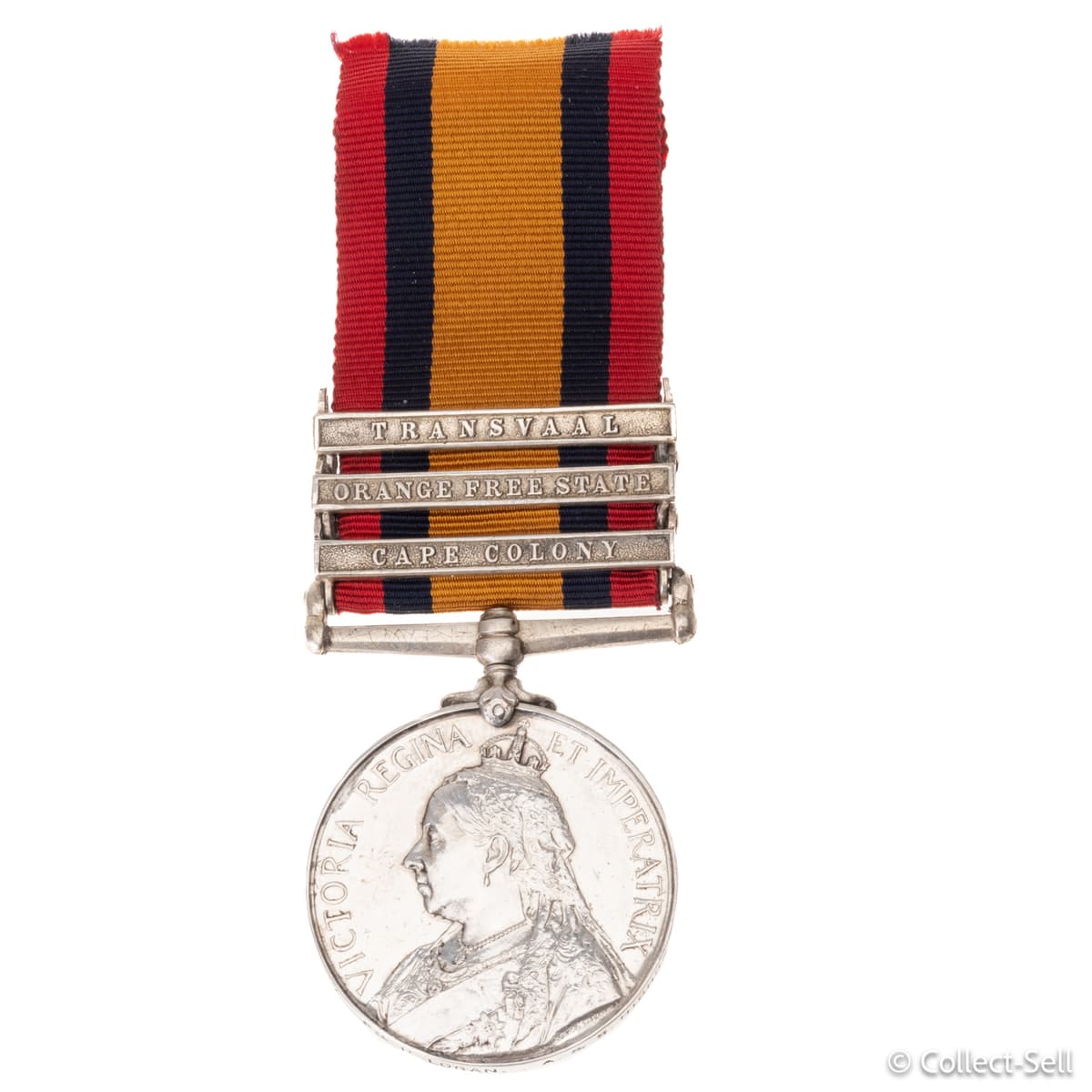
Queen’s South Africa Medal to Pte. P. Logan, Argyll & Sutherland Highlanders
Price available on inquiry
ID: 12-0336
Queen’s South Africa Medal awarded to Private P. Logan (Service No. 1917) of the Argyll and Sutherland Highlanders, with three clasps—Cape Colony, Orange Free State, and Transvaal. Issued for service during the Second Boer War, 1899–1902, this sterling silver medal features the veiled bust of Queen Victoria and Britannia on the reverse. Logan’s regiment fought in key battles including Modder River, Magersfontein, and Paardeberg. Clear impressed naming on the rim, original ribbon, and excellent patina.
Categories: 19th Century, Historical, Items, Medals and Badges, Militaria, PRECIOUS MATERIALS, SILVER, Sterling 925
Queen’s South Africa Medal with Three Clasps to Pte. P. Logan, Argyll & Sutherland Highlanders, c.1900
This original Queen’s South Africa Medal was awarded to Private P. Logan, service number 1917, of the Argyll and Sutherland Highlanders, one of Scotland’s most distinguished infantry regiments. The medal retains its original red, orange, and dark blue campaign ribbon and bears three clasps—Cape Colony, Orange Free State, and Transvaal—marking Logan’s active service across the principal theaters of the Second Boer War (1899–1902).
Medal Description
Struck in sterling silver by the Royal Mint, the obverse shows the veiled effigy of Queen Victoria with the Latin legend VICTORIA REGINA ET IMPERATRIX (“Victoria, Queen and Empress”). The reverse depicts Britannia, standing before the Union Flag and pointing toward the advancing British line under fire, with warships visible in the background—a powerful allegory of imperial strength and duty.
The medal rim is impressed:
1917 Pte. P. Logan. A. & S. Highrs.
The number “1917” is Logan’s regimental service number, not a date—a common format for Boer War-era campaign medals.
Service and Campaign History
Private Logan’s medal corresponds to service with the 1st Battalion, Argyll and Sutherland Highlanders, who embarked aboard Orcana in October 1899, landing at the Cape the following month. The battalion joined Major General Wauchope’s Highland Brigade—alongside the Black Watch, Seaforth Highlanders, and Highland Light Infantry—forming part of the British expeditionary force under Lord Methuen.
The Argylls fought in several of the war’s most significant and costly engagements:
-
Battle of Modder River (28 November 1899): Logan’s unit advanced under intense Boer fire, sustaining the heaviest losses of any battalion engaged. Despite fierce opposition, they helped secure a foothold along the riverbank that enabled Methuen’s advance.
-
Battle of Magersfontein (11 December 1899): The Argylls supported the ill-fated Highland Brigade assault, suffering severe casualties yet maintaining cohesion under withering fire.
-
Battle of Paardeberg (February 1900): Part of Lord Roberts’s encirclement of General Cronjé’s Boer forces, where their steadfast advance contributed to a major British victory.
-
Operations in the Orange Free State and Transvaal (1900–1902): The regiment marched under General Ian Hamilton’s columns through Heilbron, Balmoral, and Rustenburg, enduring long months of guerrilla warfare, convoy duty, and “drives” against Boer commandos until peace was declared in May 1902.
The Argyll and Sutherland Highlanders were repeatedly cited for courage and discipline in dispatches by Lords Methuen, Roberts, and Kitchener. Thirteen officers and twenty-seven non-commissioned officers were mentioned in despatches by war’s end.
Private Logan’s three-clasp medal perfectly aligns with this timeline of early and middle war service, indicating he served through the regiment’s hardest fighting years from late 1899 through at least 1901.
Collector Significance
The Queen’s South Africa Medal is one of the most historically evocative of all Victorian campaign awards. Logan’s example is particularly desirable due to:
-
Service with a front-line Highland regiment,
-
Three major battle clasps,
-
Clear, original naming on the rim,
-
Excellent, honest condition with original patina.
Highland regiments like the Argylls remain highly collected for their storied service and distinctive Scottish heritage. This medal captures both the grit of colonial warfare and the enduring pride of the British line infantry during the last years of Queen Victoria’s reign.
Specifications
-
Medal: Queen’s South Africa Medal
-
Material: Sterling silver
-
Diameter: 36 mm
- Gross Weight: 45.45 g (including ribbon)
-
Ribbon: Red, orange, dark blue (original)
-
Clasps: Cape Colony, Orange Free State, Transvaal
-
Recipient: 1917 Pte. P. Logan, Argyll & Sutherland Highlanders
-
Condition: Very fine to extremely fine, with period toning and clear rim impression
Provenance
Verified in the Queen’s South Africa Medal Roll, War Office WO 100/206 (Argyll & Sutherland Highlanders):
Entry: 1917 Pte. P. Logan, A. & S. Highrs – Clasps: Cape Colony, Orange Free State, Transvaal.
Historical Note
Instituted in 1900, the Queen’s South Africa Medal was awarded to all British and Colonial forces who served in South Africa between 11 October 1899 and 31 May 1902. It was the last campaign medal issued bearing Queen Victoria’s image and remains one of the most visually striking awards of the Empire period.
Obverse (Front):
Bust of Queen Victoria facing left, crowned and veiled, with the Latin inscription:
VICTORIA REGINA ET IMPERATRIX
(“Victoria, Queen and Empress”)
Reverse (Back):
A figure of Britannia holding a flag and pointing toward the advancing troops with warships offshore. The inscription reads:
SOUTH AFRICA
Ribbon:
Red, orange, and dark blue — symbolizing the British Empire and South African service.
Regiment: 1st Battalion, Argyll and Sutherland Highlanders
Service in South Africa: October 1899 – 1902
Medal Entitlement: Queen’s South Africa Medal with clasps
Likely Clasps: Cape Colony, Orange Free State, Transvaal — exactly as on your medal
These three clasps align perfectly with the regiment’s deployment timeline:
-
Cape Colony (1899–1900): Early operations including Modder River and Magersfontein.
-
Orange Free State (1900): Fighting toward Bloemfontein and Paardeberg.
-
Transvaal (1900–1902): The northern campaigns under General Ian Hamilton and later the drives toward Klerksdorp.
Historical Context
The Queen’s South Africa Medal was instituted in 1900 and awarded to British and Colonial troops who served in South Africa between October 11, 1899, and May 31, 1902.
The Argyll and Sutherland Highlanders took part in major actions including:
-
Relief of Kimberley
-
Battle of Paardeberg
-
Operations in the Orange Free State and Transvaal
Private Logan’s service with three clasps suggests he likely fought in early and middle campaigns of the war, possibly in 1899–1901.