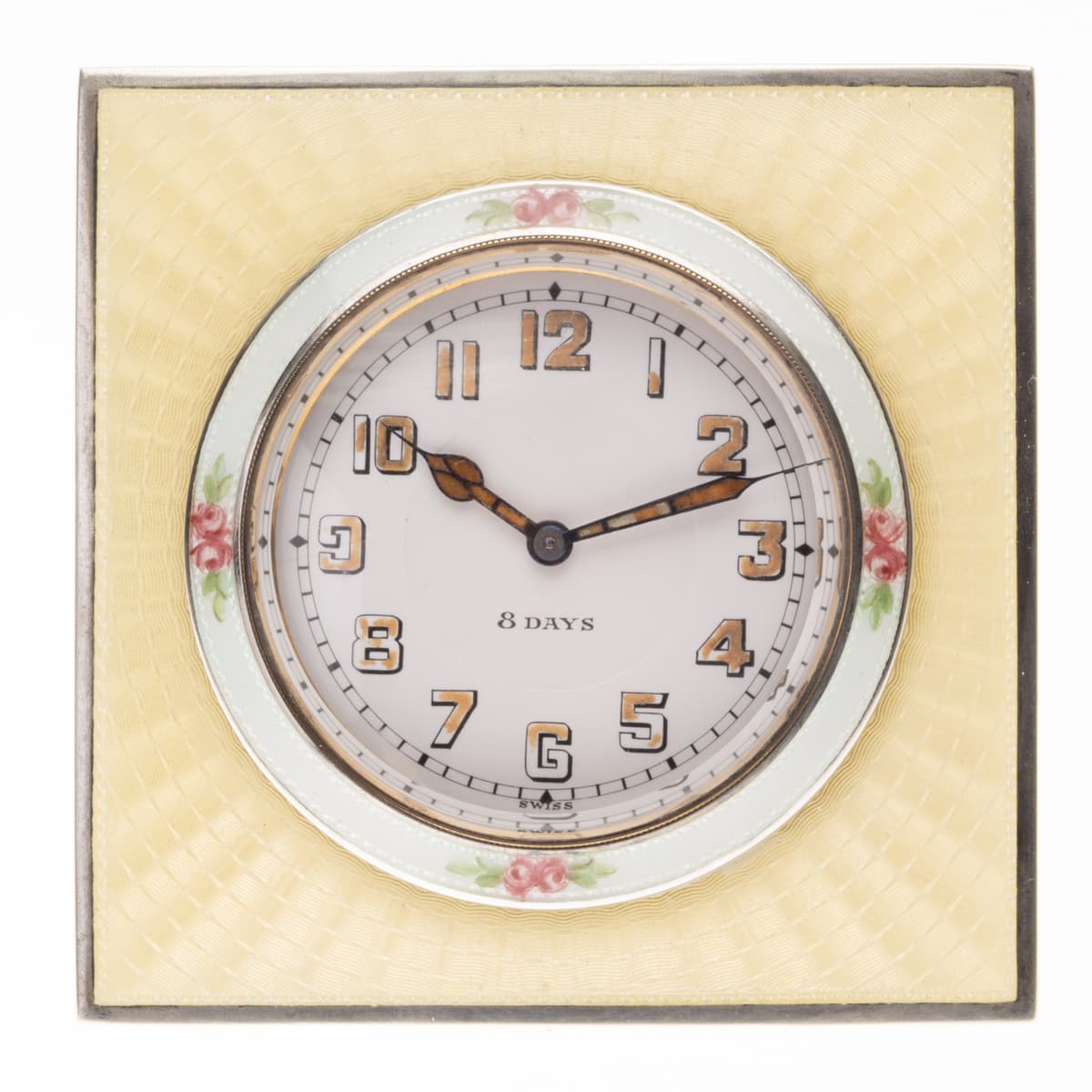
Sterling Silver Guilloché Enamel 8-Day Desk Clock
Price available on inquiry
ID: WC-14703
Art Deco sterling silver and guilloché enamel desk clock by Foster & Bailey, combining American craftsmanship with Swiss horology. The square case features a translucent yellow guilloché enamel face over an engine-turned pattern, framed by a sterling silver bezel hand-painted with rose garlands. The white single sunk enamel dial bears gilt luminescent numerals and hands, likely treated with early radium-based luminous paint — still faintly glowing under black light. The design is completed by a domed glass crystal, a folding sterling silver stand, and a Swiss 8-day movement housed in a gilt-finished back. A refined and functional collectible that exemplifies the luxury travel aesthetic of the interwar years.
Categories: 20th Century, Decorative Collectibles, Items, PRECIOUS MATERIALS, SILVER, Sterling 925
History of Foster & Bailey (Providence, Rhode Island)
Active: c. 1878 – circa 1951
Specialties: Sterling silver & silverplate novelties, vanity items, clocks, jewelry, and enamelwork
Founding and Early Years (1878–1890s)
Foster & Bailey was established in Providence, Rhode Island, around 1878 by Theodore W. Foster and Samuel D. Bailey, both experienced silversmiths and jewelry manufacturers. Providence was, at the time, one of America’s premier centers for fine silver and jewelry production home also to Gorham, Watson, and other notable firms.
The company quickly earned a reputation for high-quality silver novelties and personal accessories, including:
-
Chatelaines and lockets
-
Sterling belt buckles and brooches
-
Dresser and vanity items
-
Photograph frames and clocks
-
Enamel and guilloché silver goods
Their early production featured traditional Victorian ornamentation—repoussé scrolls, floral engraving, and pierced work—before gradually evolving into cleaner Art Nouveau and Art Deco forms by the early 20th century.
The F&B Trademark
Foster & Bailey’s pieces are stamped with the distinctive hallmark “F&B” in a flag or banner device, often accompanied by the word “STERLING.”
This mark was widely used from the 1890s through the 1930s, and remains one of the easiest identifiers for collectors today.
The firm’s attention to detail and precision in enameling positioned them in the same quality tier as Watson, Saart Bros., and Dominick & Haff for smaller decorative objects.
Transition to Theodore W. Foster & Bro. Co.
Around the early 1900s–1910s, Foster & Bailey was reorganized under Theodore W. Foster & Bro. Co., though the F&B hallmark continued to appear on many items for decades—particularly on their sterling and guilloché enamel lines.
During this period, they produced some of their finest work:
-
Art Nouveau vanity sets with pink and blue guilloché enamel
-
Compact mirrors and perfume bottles
-
Sterling clocks and frames with Swiss movements
-
Cigarette cases, card holders, and small boxes
These items blended American silver craftsmanship with imported European components (especially Swiss clock movements), much like your 8-day desk clock.
Art Deco and Later Production (1920s–1940s)
By the 1920s and 1930s, Foster & Bailey fully embraced Art Deco design — favoring geometric guilloché patterns, bright enamel colors, and mechanical novelties such as compacts with built-in watches or calendars.
Decline and Legacy
Production continued into the 1940s–early 1950s, though by then, postwar economic changes and reduced demand for fine silver novelties led to the company’s closure. The F&B mark remains well-known among collectors of:
-
American guilloché enamel
-
Early 20th-century silver clocks
-
Art Deco vanity and dresser items
Today, Foster & Bailey is considered one of the finest secondary American silversmith firms, their work admired for quality, tasteful design, and often delicate hand-enameling.
Collectibility & Recognition
Collectors prize Foster & Bailey pieces for:
-
Beautiful engine-turned guilloché enamel surfaces rivaling European standards
-
Consistent silver quality (.925 sterling)
-
Distinctive F&B hallmark in banner form
-
Integration of Swiss mechanical craftsmanship with American silver artistry
Their enamel clocks, frames, and vanity items continue to appreciate in value, particularly when enamel colors remain vivid and the original movement functions.
References
-
Rainwater, Dorothy T. American Silversmiths and Their Marks: The Definitive (1948–1978)
-
Rainwater & Fuller, Encyclopedia of American Silver Manufacturers (4th ed., 1998)
-
Online archives: Providence Jewelry History Project, Rhode Island Historical Society
-
Foster & Bailey advertising in The Jewelers’ Circular, 1901–1935